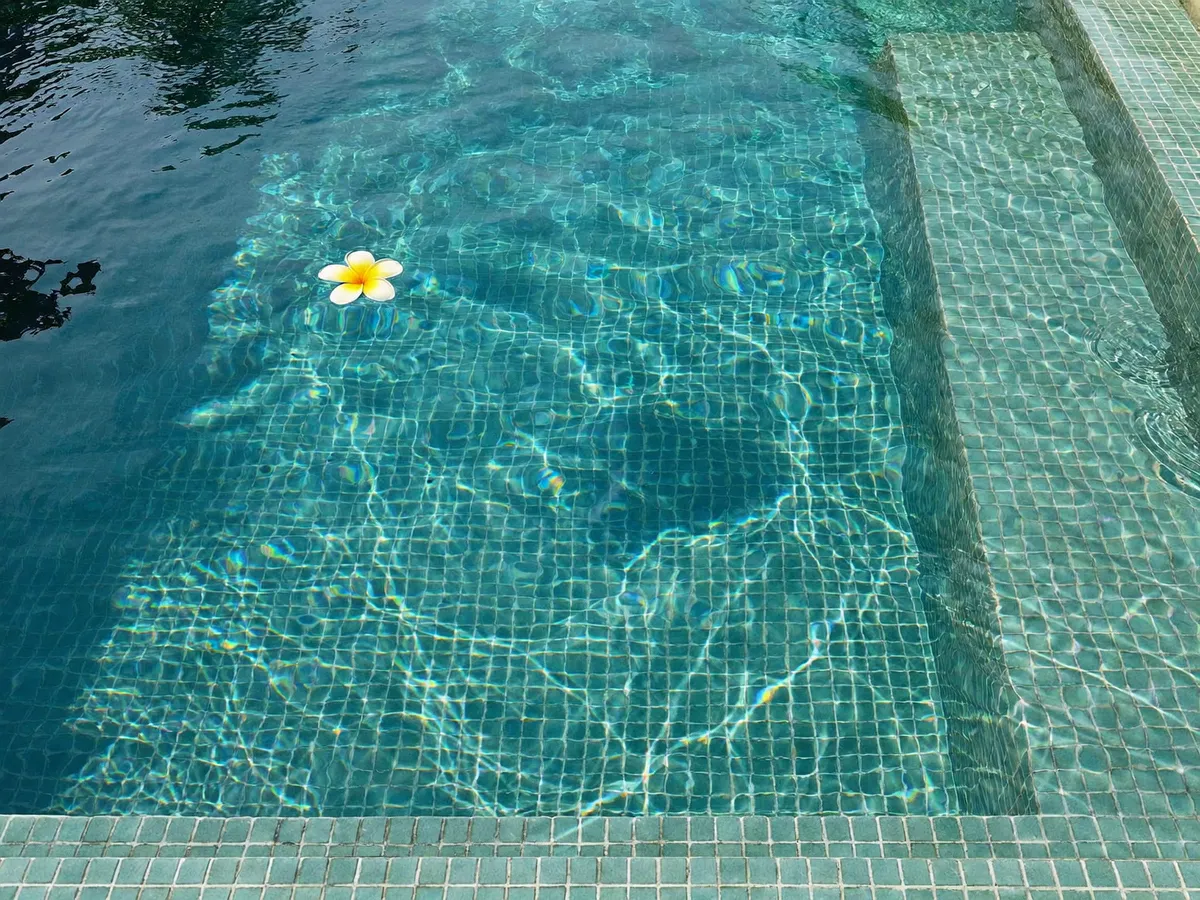
New pools, full re-tiles and waterline repairs in green Sukabumi stone, glass and ceramic mosaic, with batu candi for coping and steps — always on adhesive, waterproofing and grout rated for permanent immersion. Labour from IDR 230,000/m² for ceramic and IDR 320,000/m² for mosaic, free site visit and a tap survey of the shell before we quote.
Choosing between finishes? Our guide Bali pool tiles compared: Sukabumi stone, glass mosaic, ceramic covers looks, upkeep and grout. Balinese pool tiles have to survive things no bathroom or floor tile ever sees: permanent immersion, pool chemicals, tropical UV baking the waterline, and a concrete shell that moves daily as it heats and cools. We supply and install pool tiling for villa, hotel and residential pools across Bali — new pools, full re-tiles of failed shells, and targeted repairs — using adhesive, waterproofing and grout systems rated for continuous immersion, not standard interior products relabelled for wet areas.
Green Sukabumi stone is the material most Bali villa pools are actually finished in — a dense volcanic andesite quarried in West Java, prized for the way it turns the water a soft, natural jade-green rather than the flat blue of painted or ceramic-lined pools. It is naturally textured underfoot, so it stays non-slip on wet coping and steps without any added anti-slip treatment. Ceramic mosaic is the practical alternative: pool-rated, colour-stable, faster to lay in larger sheets, and a fraction of the cost of full stone cladding. Glass mosaic is the premium option for curved shells, benches and infinity edges — its small format follows any curve cleanly and the finish reads as a deep, glassy blue-green, though it demands the flattest setting bed and the tightest joints of anything we install. Batu candi, a darker grey andesite, is not used underwater but finishes the coping, steps and surrounding deck in the same volcanic-stone language as the pool itself, which is why most Sukabumi pools are edged in it.
Sukabumi earns its reputation honestly. The stone's own mineral content is what turns the water that distinctive green — not a dye or a liner — and the same texture that gives it colour is genuinely non-slip underfoot, a real safety point on pool steps and a wet deck used barefoot. The trade-off is that it is a natural, porous stone rather than a fired or glazed tile, so it needs periodic sealing with a breathable, penetrating sealer to keep water and algae from colonising the open pores. Skip the resealing schedule and the same stone that makes the water glow green will start growing a duller, slippery green of its own — algae, not mineral colour. We explain the difference and the resealing interval on site, and we handle it on request.
We come to the property, check the shell, sound the existing finish and measure the pool, measure and put the total in writing before any work starts. The visit costs nothing and commits you to nothing. We work in Canggu, Seminyak, Kuta and Legian, Denpasar, Sanur, Jimbaran, Nusa Dua, Uluwatu and Ubud at the same rates, with no travel surcharge.
We drain the pool fully and let the shell dry, then sound the tiled surface by tapping across it — hollow patches mean the bond has already failed even where nothing has come loose yet. This tells us whether the job is a contained repair or a full strip.
Failed tile and old adhesive come off back to sound substrate. Cracks and low spots in the shell are patched and trued so the new finish has something solid to bond to — tiling straight over a compromised shell is the single most common cause of the failures we are called out to fix.
A waterproofing system rated for permanent immersion goes on next, with particular attention to the shell-to-coping junction, steps and any pipe or light-fitting penetrations — the points where a pool almost always leaks first if this step is rushed.
Sukabumi slabs, ceramic or glass mosaic are set with waterproof, flexible adhesive at full coverage, with movement joints placed where the shell actually flexes — not skipped to save an hour's work.
We finish with pool-grade grout — cement-based or epoxy depending on the brief — that holds up to constant water contact, chlorine or salt, and UV at the waterline without chalking or eroding within a season.
The finished pool needs roughly two to three weeks to cure before it is refilled, depending on the adhesive, grout and waterproofing system used. Refilling early is the other common cause of early failure — the bond simply has not reached strength yet.
Most of the pool work we are called out for in Bali is not a new build — it is a rescue. A handful of hollow or lifted tiles, usually at the waterline or around steps, is normally a contained repair: we sound the surrounding area, strip only the affected patch, correct the bed and waterproofing locally, and reinstate matching material rather than re-tiling the whole shell. Degraded grout is an even more common call — joints that have chalked, cracked or gone porous let water track behind the tile and start the next round of hollow spots, so we rake it out and replace it with pool-grade grout before it takes tiles down with it. Either job usually needs only a partial, local drain-down of the affected zone rather than emptying the entire pool.
A Sukabumi finish wants a weekly brush to keep algae from settling into the stone's open pores, steady pool-water chemistry year-round — including the months a villa sits empty — and resealing on a periodic schedule with a breathable, penetrating sealer. Avoid harsh acid washing: it strips the surface and opens the pores wider, inviting the next bloom back faster than before. Ceramic and glass mosaic need less upkeep day to day, but the grout lines — especially the waterline band, which ages faster than the rest of the pool — are worth checking every year or two and regrouting at the first sign of erosion, before water gets behind the tile.
| Work | Labour (IDR) | Notes |
|---|---|---|
| Pool tiling — ceramic | from 230,000 per m² | Waterproof adhesive + pool grout |
| Pool tiling — glass or ceramic mosaic | from 320,000 per m² | Small format, high precision |
| Sukabumi and other natural stone | from 240,000 per m² | Immersion-rated adhesive and grout |
| Pool regrouting | from 160,000 per m² | Cement or epoxy, agreed on site |
| Loose pool tile repair | from 350,000 per tile | Call-out included; local drain-down where possible |
Materials — tile, waterproofing membrane, adhesive and grout — are quoted separately after the site visit. Draining, shell repair and curing time are built into the schedule we give you in writing. All rates side by side are on the tiling price list.
We also handle pool decks and terraces, natural stone coping and surrounds, bathroom tiling and tile repair, and every pool we tile gets the same immersion-rated waterproofing logic we explain in waterproofing before tiling. All across Bali, same rates, no travel surcharge.
A pool is the most demanding surface any Bali villa asks a tiler to finish. Get the waterproofing, adhesive and grout right for continuous immersion and the finish outlasts the pool equipment around it — skip one of those three and it is only a matter of time before it comes back as a repair job.