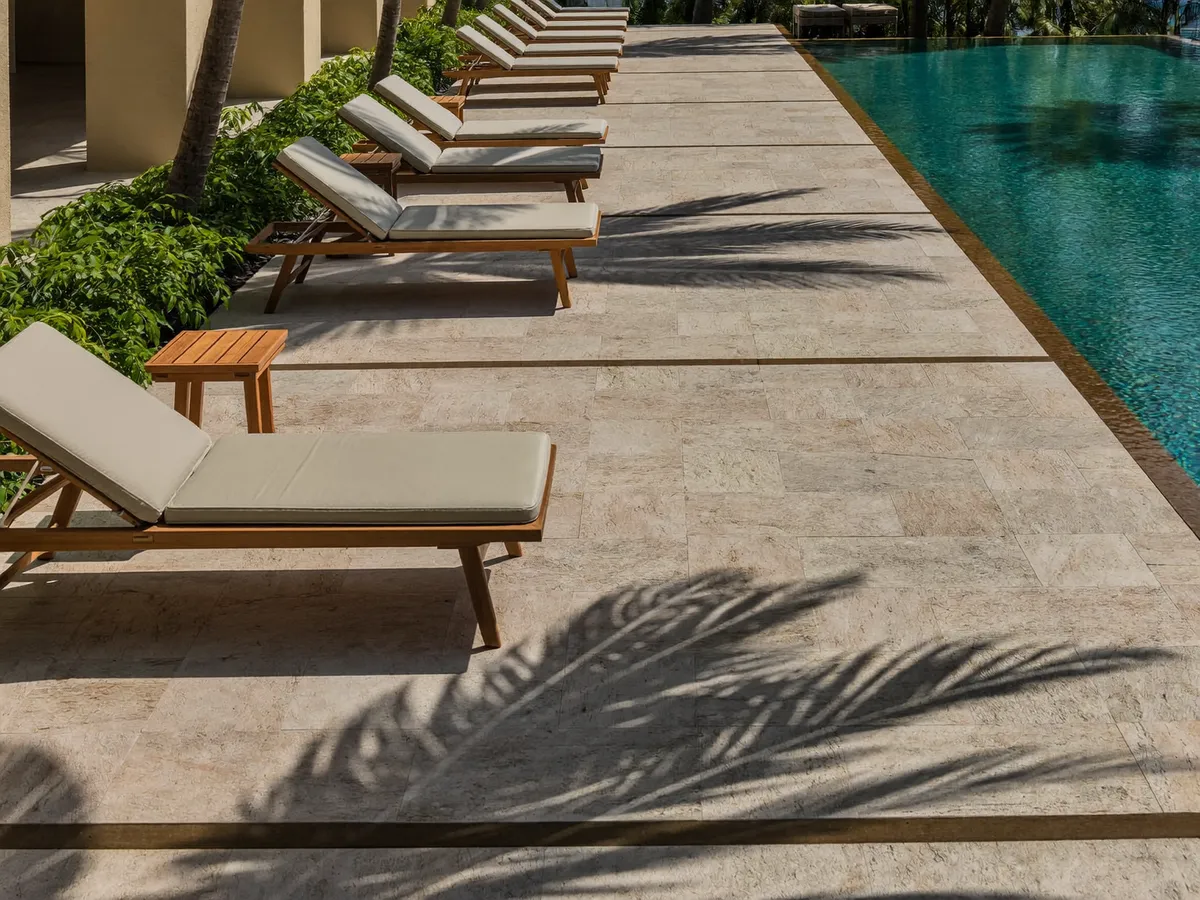
We lay and seal paras, palimanan, andesite, limestone, slate, marble and terrazzo tiles on floors, feature walls, terraces and pool coping — stone chosen for where it will live, bedded in the right adhesive, sealed before handover. Labour from IDR 210,000/m², supply-and-install or your own stone, free site visit before the price is fixed.
Nothing gives a Bali villa its sense of place like natural stone: a cool limestone floor, carved paras on a feature wall, speckled terrazzo around a pool. Stone is also the least forgiving surface in Bali's climate. Put the right stone in the right place and seal it, and it ages well for decades; get either wrong and you fight stains, algae and crumbling edges within one wet season. These are the stones we lay most:
The most common natural stone failure in Bali is the right stone in the wrong place. Indoors, in dry and sheltered rooms, you have the most freedom: marble, polished limestone, terrazzo and paras feature walls all perform well because rain, salt and hard UV never reach them.
Outdoors and around water the rules tighten. A garden path, terrace or pool surround faces monsoon rain, strong sun and, near the coast, salt-laden wind. There you want dense, anti-slip stone — andesite, hard limestone or slate — sealed properly. Soft paras and polished marble stain, grow algae and erode in those conditions. Coastal Canggu, Seminyak and the Uluwatu clifftops are the harshest; inland Ubud trades salt for damp and moss, which favours stone that dries quickly. For terraces see also outdoor and terrace tiling.
Stone varies from crate to crate in colour, veining and thickness. We open the delivery, check it for consistency and dry-lay feature areas first, so veining runs the way you want and odd pieces end up in cupboards, not in the middle of the living room.
Stone needs a flat, sound screed and an adhesive made for natural stone — light-coloured under pale marble and limestone so it does not shadow through, exterior-grade outdoors, immersion-rated at the pool. Full coverage, no dabs.
Local stone and hard porcelain are cut on a wet saw with a diamond blade for clean edges. We keep joints even, place movement joints on large or sun-exposed areas and use flexible sealant at wall and threshold junctions.
Porous stone is sealed with a penetrating, breathable sealer once it is clean and dry, and we explain the re-sealing interval for your location before we leave.
Almost every stone we install is porous, so it is sealed on installation and re-sealed periodically — roughly once a year outdoors and in wet areas, every one to two years in dry rooms, more often on the coast. A sealed stone lets you wipe a spill away; an unsealed one drinks it in. Day to day, use pH-neutral cleaners only: acidic products etch limestone, marble and travertine. Keep damp inland surfaces ventilated and free of standing water to slow algae, and put mats at entrances so grit does not wear the surface. The full schedule and the water-drop test are in our natural stone sealing guide.
Quarry quality varies, and a stone that looks perfect in a supplier's yard can behave very differently once laid and exposed. We can source paras, palimanan, limestone, slate, terrazzo, marble and andesite, check the batch, and handle delivery, layout, cutting, fixing and sealing as one job — one team answers for the whole result, with no finger-pointing between supplier and tiler. If you have fallen for a soft stone that will not survive your poolside, we tell you before any money is spent and suggest a harder stone with a similar look. If you prefer to buy your own stone, we install it and tell you honestly whether it suits its location first.
We check the base, measure and look at the stone or samples before putting the price in writing. The visit costs nothing and commits you to nothing. We work in Canggu, Seminyak, Kuta and Legian, Denpasar, Sanur, Jimbaran, Nusa Dua, Uluwatu and Ubud at the same rates, with no travel surcharge.
| Work | Labour (IDR/m²) | Notes |
|---|---|---|
| Natural stone floors and walls | from 210,000 | Marble, travertine, limestone, terrazzo tiles |
| Andesite terraces and paths | from 210,000 | Anti-slip, sealed on handover |
| Sukabumi pool stone | from 240,000 | Immersion-rated adhesive and grout |
| Regrouting stone floors | from 140,000 | Re-seal quoted with the job |
Labour prices per m²; stone, adhesive, grout and sealer are quoted separately. Carving, book-matching and cladding on high walls are quoted after the site visit. All rates are on the tiling price list.
Stone often comes with other work: floor tiling in porcelain for the rest of the villa, terraces and pool decks, pool tiling, bathrooms in honed stone and repairs to cracked or stained stone. For the wider picture see the complete tiling guide.