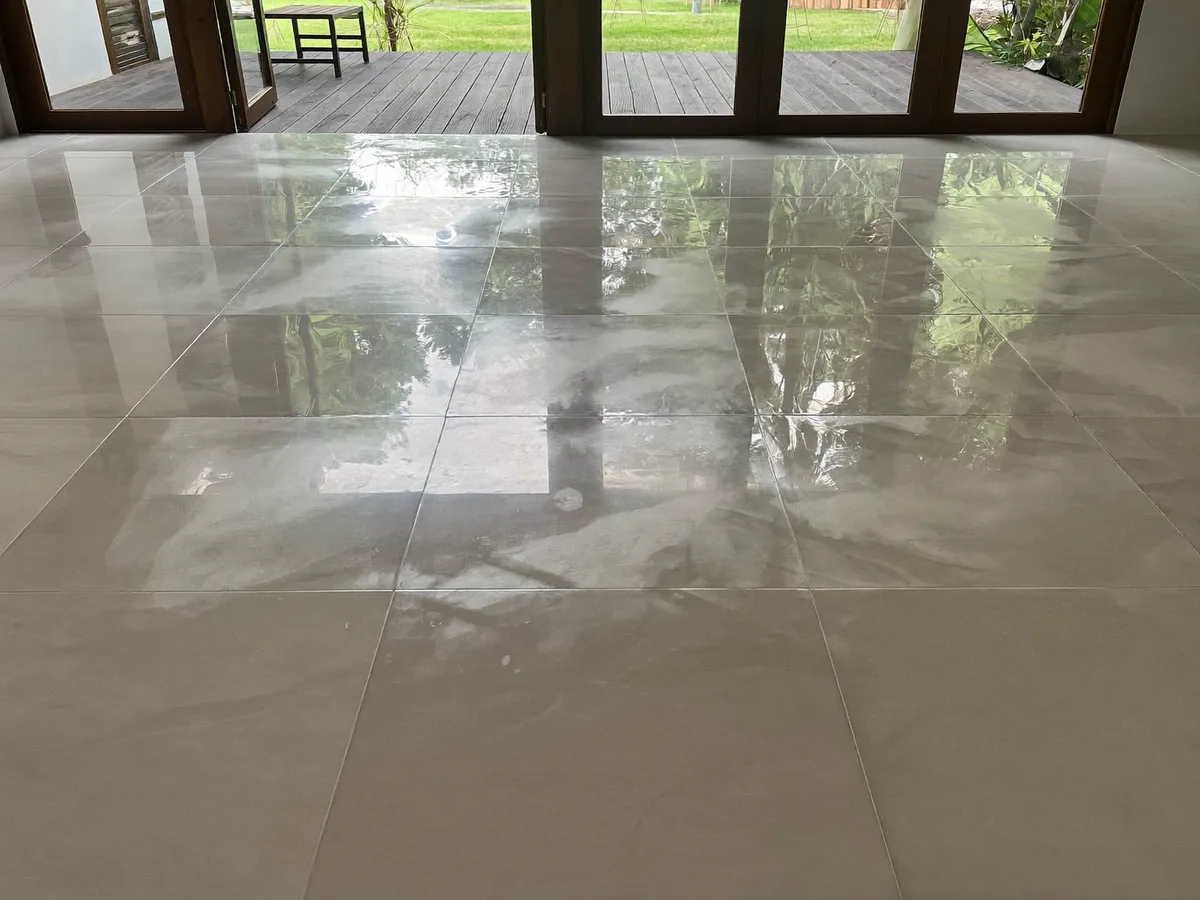
Living rooms, bedrooms, kitchens and indoor-outdoor runs in porcelain, ceramic, large-format slabs and natural stone — laid on a levelled base, with movement joints where the slab needs room to move. Labour from IDR 130,000/m² for straight lay, free site visit and a fixed quote before we start.
A tiled floor is only as good as what it sits on. The failures we get called to rescue around Bali repeat themselves: a wavy substrate nobody flattened, movement joints nobody cut, indoor adhesive sent outside to die, glossy tile laid where wet feet need grip. We deal with all four before the first tile is bedded — then lay straight, diagonal or pattern, indoors or out.
We come to the property, check the slab with a straightedge, look for hollow or damp patches, measure and put the total in writing before any work starts. The visit costs nothing and commits you to nothing. We work in Canggu, Seminyak, Kuta and Legian, Denpasar, Sanur, Jimbaran, Nusa Dua, Uluwatu and Ubud at the same rates, with no travel surcharge.
Floor tiling lives or dies on the substrate. We level the screed before laying rather than burying dips under thick adhesive, which is how hollow, rocking tiles happen. On uneven Bali concrete this prep is often the largest part of the job — and the part shortcut crews skip.
We set out the floor from the centre and the main sightlines so cuts are balanced and corners don't end up with fragile slivers. For large-format tiles, a flat substrate and a planned layout are the difference between a flawless floor and visible lippage between tiles.
The right adhesive for the location — interior, wet area or outdoor — applied with full back coverage. Interior adhesive used outdoors is the number-one reason outdoor floor tiles lift after one rainy season; we never make that swap.
On larger floors and any indoor-outdoor run we include expansion joints so tiles don't buckle in the heat. Then clean grouting and a final check for any hollow or proud tile before we call it finished.
Most floor jobs are living areas, bedrooms, kitchens, hallways and the indoor-outdoor runs that Bali villas are built around. Level substrate and full adhesive coverage decide whether the result lasts, whether it is one room or a whole villa layout. We also tile walls: kitchen splashbacks, feature walls and the dry walls around a new floor. Wall tiling in Bali needs careful setting-out and an adhesive that holds in humidity, so tiles do not slip while curing or debond a year later.
Some jobs have their own page because the method changes: wet rooms start with a membrane (bathroom tiling), exposed terraces need anti-slip tile and a drainage fall (outdoor and terrace tiling), pools need immersion-rated systems (pool tiling), and marble, andesite or paras floors need stone-specific adhesive and sealing (natural stone installation).
The climate punishes the wrong material quickly, so choosing a floor tile is never only about looks. Porcelain is the low-maintenance default for floors: it is dense and barely porous, shrugs off humidity, stains and heavy foot traffic, which is why it dominates rental villas. Glazed ceramic is a cheaper indoor option but more brittle, and it does not belong outdoors or under heavy loads.
Large-format porcelain — 60×120 cm slabs and bigger — gives the clean, few-joints look many villa owners want, but it is the least forgiving tile to lay. It needs a flat screed, full back-buttering and, over a young or moving slab, a decoupling layer; otherwise you get lippage between tiles and cracks along the long edge. Softer natural stones — limestone, travertine, marble and terrazzo tiles — are beautiful but porous: they need sealing and belong in dry, sheltered rooms. Terracotta brings warmth to courtyards but absorbs water and must be sealed and maintained. Our complete tiling guide compares each material by location.
An indoor floor and a terrace can use the same tile and still need opposite priorities. Indoors the job is flatness and coverage: a level screed, a planned layout, full adhesive contact and movement joints on long runs. Outside, the floor faces direct sun, monsoon downpours, daily thermal movement and — near the coast — salt. There the priorities are an anti-slip rating for wet feet, exterior-grade adhesive as a full bed, salt-resistant grout in coastal areas such as Canggu, Seminyak and Uluwatu, and a drainage fall built into the screed. Where an open-plan living room runs straight onto a terrace, we place a movement joint at the threshold so the two halves can move independently.
Floor tiles fail in Bali for predictable reasons: an uneven substrate that wasn't levelled, missing expansion joints on a big or sun-exposed floor, the wrong adhesive used outdoors, or no anti-slip rating in a wet area. We design each of these out at the start rather than leaving the client to discover them a year later.
| Work | Labour (IDR/m²) | Notes |
|---|---|---|
| Floor tiling — straight lay | from 130,000 | Ceramic or porcelain |
| Floor tiling — diagonal / herringbone | from 180,000 | More cuts and waste |
| Large-format porcelain | from 200,000 for 60×120 · quoted after visit | Depends on slab flatness and size |
| Natural stone floors | from 210,000 | Marble, travertine, limestone, andesite |
| Outdoor / terrace floors | from 150,000 | Anti-slip tile, exterior adhesive |
Labour prices; tiles, adhesive, grout and membrane are quoted separately, and we can source tiles at trade prices from Bali suppliers or lay tiles you already own. Minimum job 5 m². A quote that looks much cheaper than the rest usually leaves out the things that make a floor last: levelling the screed, a decoupling layer under large-format tile, movement joints. Compare quotes line by line and ask whether that prep is included. All rates are on the tiling price list.
We also handle bathroom tiling, outdoor and terrace tiling, natural stone installation, pool tiling and tile repair. All across Bali, same rates, no travel surcharge.
Whether it is a single room, a full villa floor or an indoor-outdoor run that flows onto a terrace, we treat the substrate as seriously as the tile itself. That is the part you cannot see once the floor is finished, and it is the part that decides how the floor performs for the next decade.